
By Derim “Mike” Vinca, Owner of A-1 Milwaukee Heating & Cooling · 17+ years in the trade · Updated October 2026 · More HVAC guides
Most no-cool calls in a Milwaukee summer come down to a handful of causes, and a few of them you can check yourself in ten minutes. Go through these in order. If the house is still warm at the end, call or text 414-595-5175.
Before you touch the outdoor unit, switch the thermostat to Off. Never open the electrical panel on the condenser; the capacitor inside holds a charge even with the power off.

1. Thermostat
Set it to Cool, set the temperature a few degrees below the room, and set the fan to Auto. If the screen is blank, replace the batteries. If you have a smart thermostat, check that a schedule or an away mode is not overriding you.
2. Breakers and the outdoor disconnect
Central air usually has its own double breaker in the panel, and the furnace that moves the air has its own switch or breaker too. Check both. Next to the outdoor unit there is a disconnect box; make sure it is switched on or the pull-out block is seated. If a breaker trips again after you reset it, stop and call; something is shorting.
3. The filter
A filter packed with dust starves the indoor coil of air. The coil gets too cold, freezes, and the house stops cooling. Pull the filter; if you cannot see light through it, replace it.
4. Look and listen at the outdoor unit
With the thermostat calling for cooling, the outdoor fan should spin and the unit should run steadily. If the fan is not turning but the unit hums, it is often a failed capacitor; switch the thermostat to Off to protect the compressor and call. Clear leaves, grass clippings and cottonwood fluff from around the unit; with the power off you can gently rinse the outside of the coil with a garden hose, never a pressure washer.
5. Ice on the lines or the indoor coil
Ice on the copper lines or frost on the indoor coil means low airflow or low refrigerant. Switch cooling off, set the fan to On for a few hours to melt it, replace the filter, and call. Turning it back on without fixing the cause usually means it freezes again.
6. The condensate drain
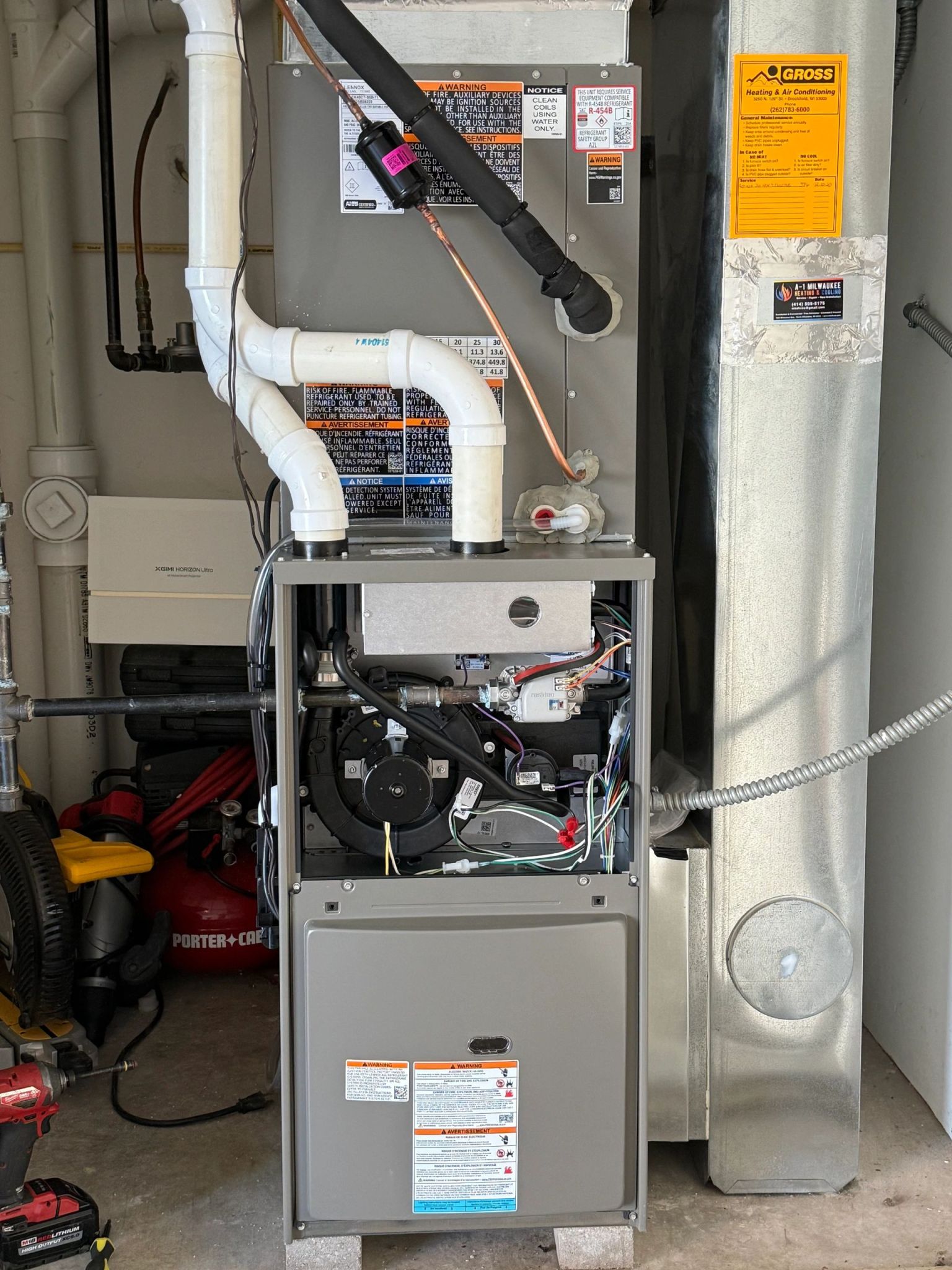
Many systems have a float switch that shuts the AC off when the drain line clogs, so the overflow does not leak into your basement or ceiling. Look for standing water in the drain pan under the indoor coil or in the condensate pump. Algae in the line is common by late summer.
Still not cooling? Here is what it probably is
If the checks above did not fix it, the most common causes are a failed capacitor or contactor at the outdoor unit, a refrigerant leak, a failed outdoor fan motor, a dirty or frozen indoor coil, or, on older systems, a compressor at the end of its life. Systems that still use R-22 refrigerant are expensive to recharge because R-22 is no longer produced, and that changes the repair-or-replace math.
What to expect when you call A-1
Calls ring Mike’s cell at any hour, and you get a real arrival window. On site we measure the refrigerant pressures, temperatures and amp draws, show you the readings, and quote a flat-rate price before touching anything. Repairs are guaranteed for one year, parts and labor. More on our AC repair and 24/7 emergency service. Typical replacement prices are in our Milwaukee HVAC price guide.
Frequently asked questions
Why is my AC running but the house is still warm?
Usually low airflow (a clogged filter, a dirty coil or a weak blower), low refrigerant from a leak, or an outdoor unit that has stopped while the indoor fan keeps running. On the hottest days a properly sized system can run nonstop and still fall a few degrees behind; that is normal. If it falls further behind every day, something is wrong.
Should I keep running an AC that has ice on it?
No. Switch the thermostat from Cool to Off, set the fan to On so the ice melts, and call. Running it frozen can damage the compressor, the most expensive part of the system.
How fast can you come for no cooling?
Same day in most cases across Milwaukee and Waukesha counties. Calls ring Mike’s cell at any hour, and you get a flat-rate price before any work starts.